← Back to the notebook

Sources.

Each collage on this site is made from works in open museum collections. Here is each one, with its sources and their licences.

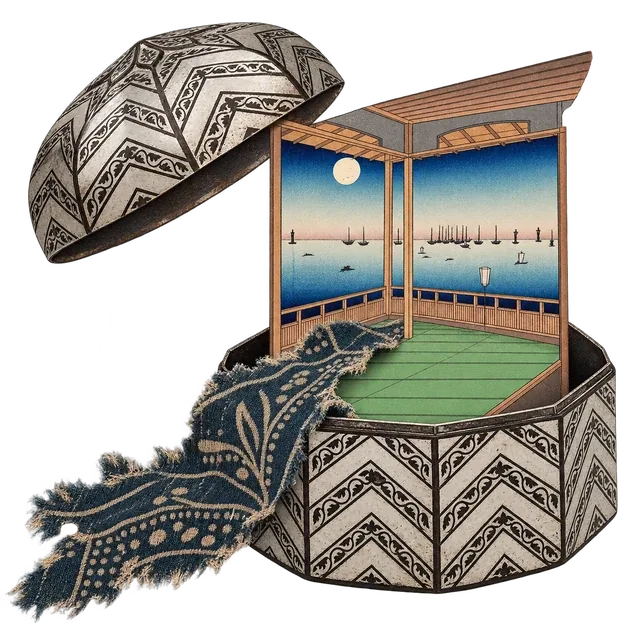
An open bidri box with a veranda inside it, looking out over a moonlit bay, and a strip of indigo cloth spilling over the side.

DA.26.01

The Room We Carry

Collage after Hiroshige’s Moon-Viewing Promontory, a bidri paan box (c. 1700) and a textile fragment (1100s–1300s).

  1. The Moon-Viewing Promontory, from One Hundred Views of Famous Places in EdoUtagawa Hiroshige (Japanese, 1797–1858) · The Cleveland Museum of Art · CC0 1.0Used: Empty wooden architecture, green floor, blue sea and moon; text and figures omitted.
  2. Bidri Pandan with ChevronsArtist not recorded · The Cleveland Museum of Art · CC0 1.0Used: The black-and-silver chevron paan box, its base and lifted lid.
  3. FragmentUnknown · The Cleveland Museum of Art · CC0 1.0Used: A frayed strip of indigo cloth.
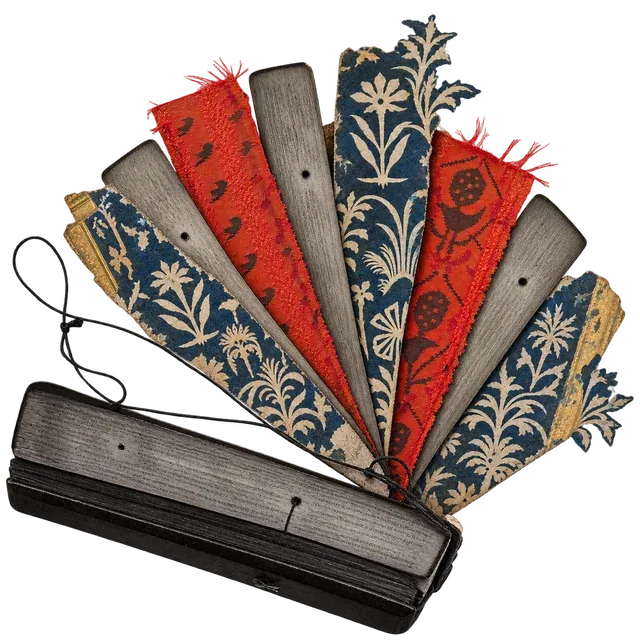
A bound palm-leaf manuscript fanned open into eight leaves of palm leaf, red woven cloth and indigo cut paper, with a loose black cord.

DA.26.02

Eight Leaves

Collage after a Pali manuscript (1700s), a cut-paper album page (1625–50) and a peacock border (1600s).

  1. Pali ManuscriptArtist not identified in catalogue · The Metropolitan Museum of Art · CC0 1.0Used: Monochrome palm-leaf book, ridged leaves and loose black binding thread; writing omitted.
  2. Album Page with Cut-Paper DecorationArtist not identified in museum catalogue · The Metropolitan Museum of Art · CC0 1.0Used: Indigo botanical cut-paper surface and cream plant silhouettes; calligraphy omitted.
  3. Border with Peacock DesignUnknown · The Cleveland Museum of Art · CC0 1.0Used: Vermilion woven textile, black motif fragments and frayed edges.
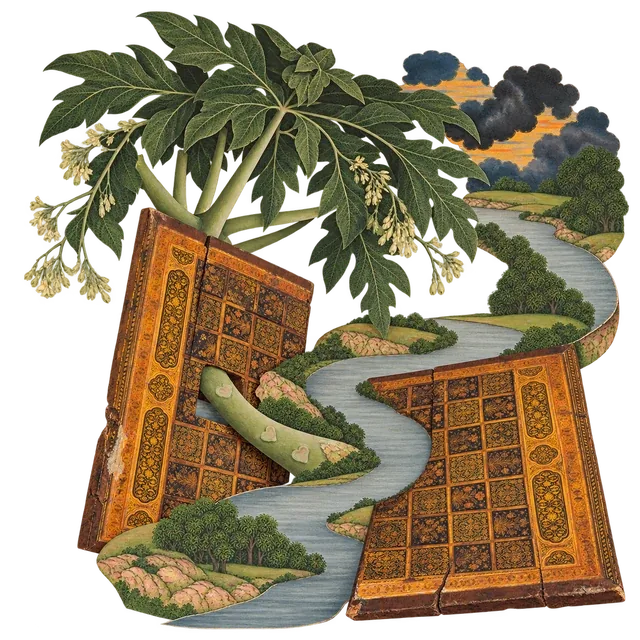
A river runs between the two halves of a gold inlaid game board, under a papaya tree and storm clouds.

DA.26.04

The World Unfolds Sideways

Collage after an inlaid game board (1600s), a river at the forest’s edge (1700s) and a papaya tree (1790s).

  1. Painted and Inlaid Game BoardUnknown · The Metropolitan Museum of Art · CC0 1.0Used: The two halves of the wooden board, with their floral squares and worn gold.
  2. Women Enjoying the River at the Forest’s Edge (recto)style of Hunhar II (Indian, active mid-1700s) · The Cleveland Museum of Art · CC0 1.0Used: River, green banks and small cloud fragments, people omitted.
  3. Male Papaya TreeArtist not recorded · The Metropolitan Museum of Art · CC0 1.0Used: Oversized papaya leaf canopy and clipped stem, paper background omitted.
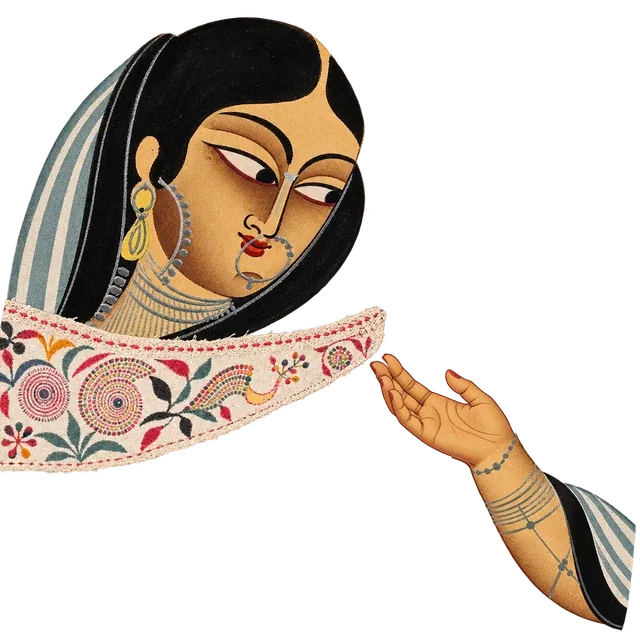
A woman in a striped veil looks down; across a strip of kantha embroidery, a hand reaches towards her.

DA.26.07

The Distance of a Hand

Collage after a gouache of a courtesan at her hair, a watercolour of a woman with a pitcher and a Bengal kantha (1800s).

  1. A courtesan arranging a flower in her hair. Gouache painting by an Indian artist, 1800s.Unidentified Indian artist (catalogue attribution) · Wellcome Collection · Public Domain MarkUsed: The lowered gaze, curved eye and fine red mouth, blended into the face from the pitcher painting.
  2. A woman holding a pitcher. Watercolour.Artist not identified in catalogue · Wellcome Collection · CC BY 4.0Used: The face, the edge of the grey-black drapery and the open hand; pitcher omitted.
  3. KanthaArtist not recorded · The Cleveland Museum of Art · CC0 1.0Used: An off-white kantha strip with patterned stitching, widened.
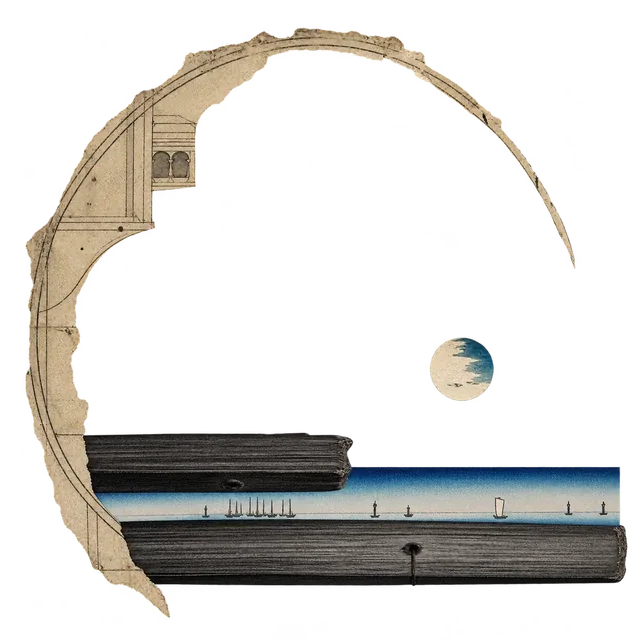
A half-drawn pencil arch over two black manuscript edges, with a small moon and a thin strip of blue sea.

DA.26.08

The Interval Before Dawn

Collage after Radha’s hair being dressed (c. 1795), a Pali manuscript (1700s) and Hiroshige’s Moon-Viewing Promontory.

  1. Radha's hair being dressedArtist not identified in museum catalogue · The Cleveland Museum of Art · CC0 1.0Used: Empty unfinished arch and architectural construction lines; every figure, face and writing omitted.
  2. Pali ManuscriptArtist not identified in catalogue · The Metropolitan Museum of Art · CC0 1.0Used: Two black monochrome manuscript edges with binding holes and ridges, text omitted.
  3. The Moon-Viewing Promontory, from One Hundred Views of Famous Places in EdoUtagawa Hiroshige (Japanese, 1797–1858) · The Cleveland Museum of Art · CC0 1.0Used: Pale moon and thin blue horizon strip; room, people and labels omitted.
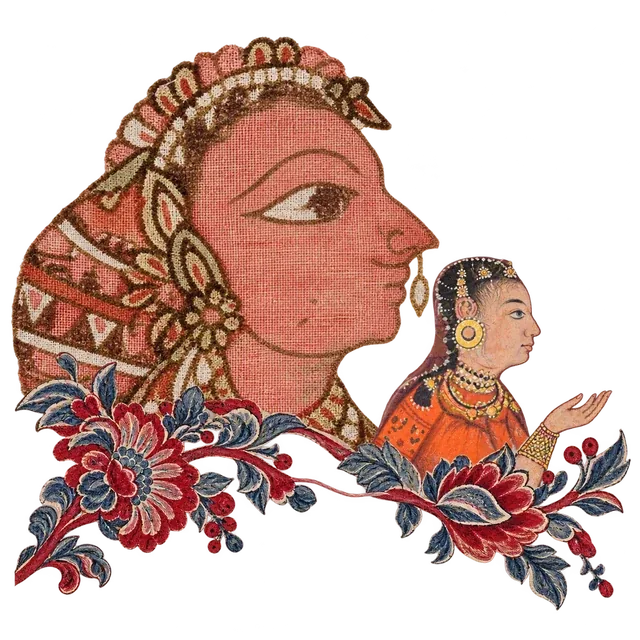
A large woman's profile in printed chintz and a small painted woman with her hand raised, joined by a red and blue flowering branch.

DA.26.09

A Branch Between Them

Collage after a Hikone chintz (1600s), a Tuti-nama page (c. 1560) and a palampore (1700s).

  1. Chintz (Hikone Chintz) with a Woman with a Bird on Her HandUnknown · Tokyo National Museum · CC BY 4.0Used: The large salmon-pink profile with its patterned veil; bird and body omitted.
  2. The parrot addresses Khujasta at the beginning of the fifty-second night, from a Tuti-nama (Tales of a Parrot): Fifty-second NightArtist not identified in museum catalogue · The Cleveland Museum of Art · CC0 1.0Used: A small woman's profile and raised hand; cage, architecture and calligraphy omitted.
  3. PalamporeArtist not recorded · The Metropolitan Museum of Art · CC0 1.0Used: A red and blue flowering branch, extended to run across both figures.
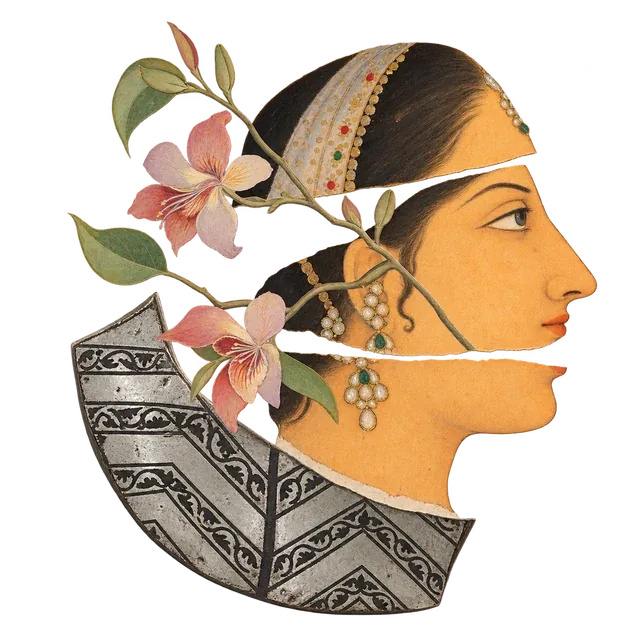
A woman's profile cut into three bands, crossed by an orchid branch, above a curved piece of bidri metal.

DA.26.12

A Face in Three Bands

Collage after a princess on a terrace at night (c. 1760), a bidri paan box (c. 1700) and Zain al-Din’s thrush and moth (1778).

  1. A Princess on a Terrace with Attendants at Night (recto)Artist not identified in museum catalogue · The Cleveland Museum of Art · CC0 1.0Used: The princess's head in profile, cut into three bands; other figures and setting omitted.
  2. Bidri Pandan with ChevronsArtist not recorded · The Cleveland Museum of Art · CC0 1.0Used: A curved piece of the black-and-silver chevron metal.
  3. An Orange-Headed Ground Thrush and a Death's-Head Moth on a Purple Ebony Orchid BranchShaikh Zain al–Din · The Metropolitan Museum of Art · CC0 1.0Used: Slender orchid branch and two pale pink blooms, bird, moth and labels omitted.
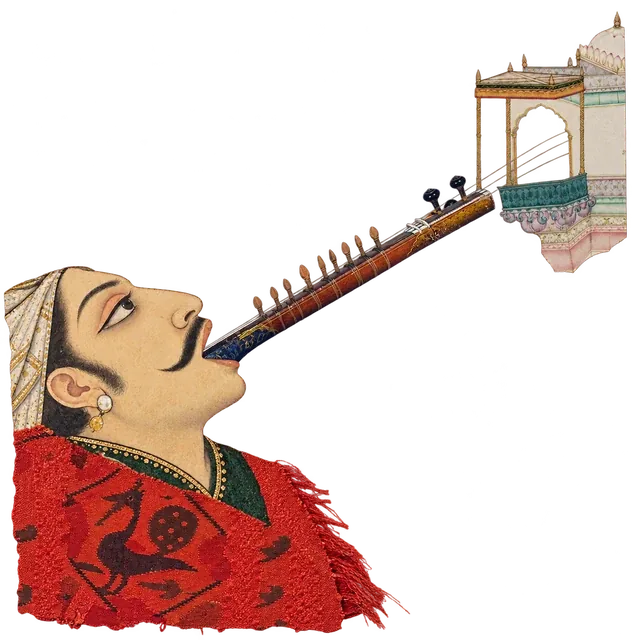
A musician in a red shawl tips his head back; the neck of a lute runs from his lips up to a small palace balcony.

DA.26.14

Up to the Balcony

Collage after a Krishna on a palace balcony (1770s), a taus (1800s) and a peacock border (1600s).

  1. Krishna and Consort on a Palace Balcony with Musicians: Vukharo Ragaputra of Bhairav, from the “Boston Ragamala”Artist not identified in museum catalogue · The Cleveland Museum of Art · CC0 1.0Used: Foreground musician's upturned head and small empty balcony arch fragment, lettering and other figures omitted.
  2. Taūs (mayuri)Artist not recorded · The Metropolitan Museum of Art · CC0 1.0Used: The lacquered neck, strings and pegs, and a small blue fragment.
  3. Border with Peacock DesignUnknown · The Cleveland Museum of Art · CC0 1.0Used: Red woven textile shoulder fragment with frayed edges and black motifs.
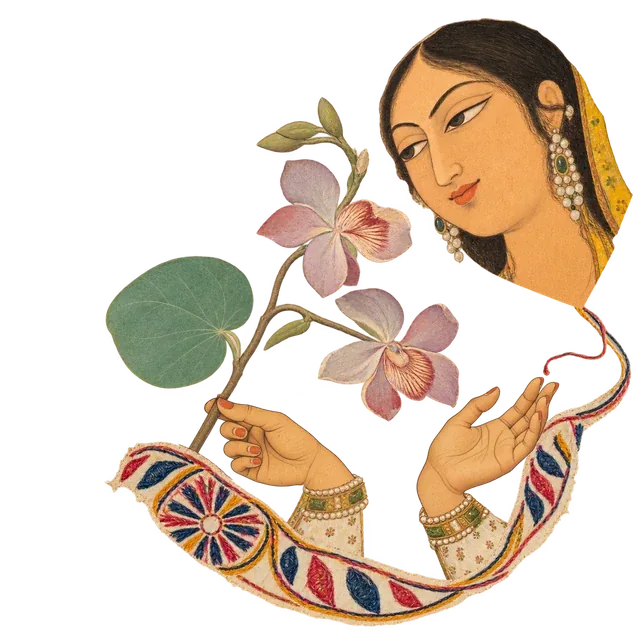
A woman looks down at two open hands holding an orchid branch over a strip of embroidered cloth.

DA.26.15

Room for the First Thought

Collage after a princess on a terrace at night (c. 1760), Zain al-Din’s thrush and moth (1778) and a ceremonial kantha (1800s).

  1. A Princess on a Terrace with Attendants at Night (recto)Artist not identified in museum catalogue · The Cleveland Museum of Art · CC0 1.0Used: The far-right yellow-clad musician's tilted face, and the central woman's raised hands, enlarged at different scales.
  2. An Orange-Headed Ground Thrush and a Death's-Head Moth on a Purple Ebony Orchid BranchShaikh Zain al–Din · The Metropolitan Museum of Art · CC0 1.0Used: Orchid flowers, curved branch and green leaf as separate cut paper fragments.
  3. Kantha (Ceremonial Quilt)Artist not recorded · The Cleveland Museum of Art · CC0 1.0Used: Narrow frayed strips of embroidered cloth with their red, indigo and yellow stitches.
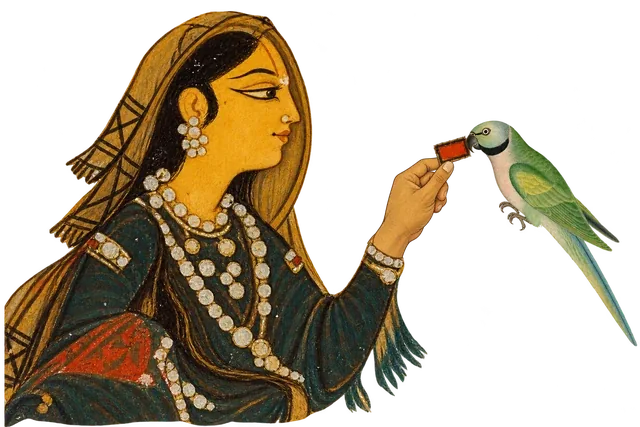
A woman in a green dress holds out a small red card to a green parrot.

DA.26.17

A Word Takes Wing

Collage after a woman with seven documents (1800s) and a green parrot (c. 1820).

  1. A Woman with Seven Documents, Number Seven of the Barat (Document) Suit, Playing Card from a Mughal Ganjifa SetUnknown · Los Angeles County Museum of Art · Public domain — LACMA unrestricted downloadUsed: Painted female profile, teal clothing, jewellery, extended hand and one vermilion document rectangle; enlarged and rearranged, original circle and all writing omitted.
  2. Green ParrotArtist not recorded · Cleveland Museum of Art · CC0 1.0Used: The green parrot and its blue tail, redrawn holding the edge of the red card; tree, labels and paper omitted.
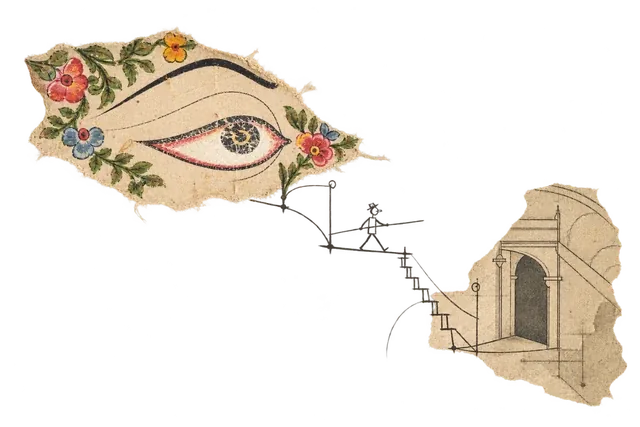
A large painted eye on a scrap of flowered cloth looks along a tightrope, where a tiny figure walks towards a stair and an open doorway.

DA.26.19

A Window Went Walking

Collage after four paintings in the Auckland Museum, Paul Klee’s Tightrope Walker and Radha’s hair being dressed (c. 1795).

  1. paintings (4)Unidentified · Auckland War Memorial Museum Tāmaki Paenga Hira · CC BY 2.0Used: Large eye and adjacent pink, blue and yellow flowers on a frayed pale textile fragment; original figures, banners and writing omitted.
  2. Tightrope WalkerPaul Klee (German, 1879–1940) · The Cleveland Museum of Art · CC0 1.0Used: The fine black lines and the tiny balancing figure, redrawn as a crooked stair to the doorway; paper ground and signature omitted.
  3. Radha's hair being dressedArtist not identified in museum catalogue · The Cleveland Museum of Art · CC0 1.0Used: Open doorway, narrow architectural fragment and partial arched construction lines; people and writing omitted.

Sound

Hour